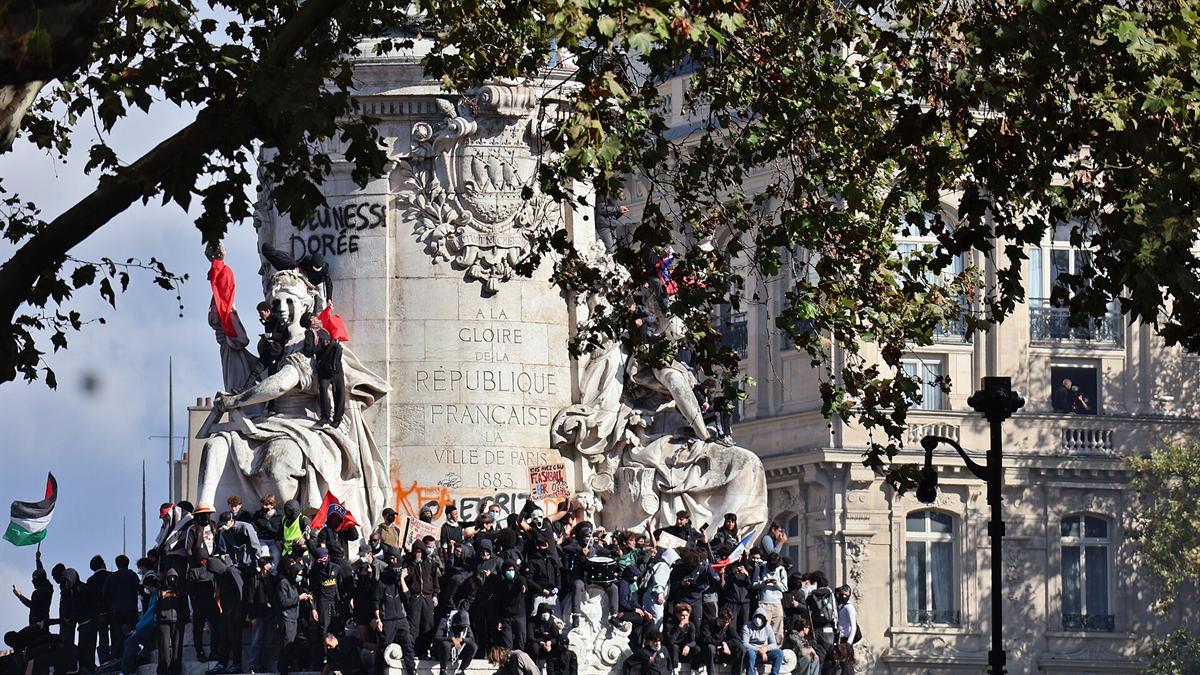
(The Turkish Post) – France protests over the cost of living drew about 550,000 people onto the streets on Oct. 17, according to the Interior Ministry, as students, trade unions and the revived Yellow Vests movement marched together and police arrested around 400 people after clashes in several cities.
Organizers put the turnout at about 800,000. The marches come after weeks of student protests and about six months before the presidential election that will choose President Emmanuel Macron’s successor.
France protests turn violent in several cities
Interior Minister Laurent Nunez said 110,000 people marched in Paris. Most of the France protests passed off peacefully, but masked groups clashed with police in the capital and other cities.
In Paris, police fired tear gas and used water cannon, and several parked cars were set on fire. More than 300 protesters tried to march up the Champs-Elysees.
In Lyon, protesters set fire to a tourist office in the city center. Demonstrators forced their way into the town halls of Marseille and Lille, and dozens of shops were looted in Marseille, Lille and Nice. In Lille, an Apple store was ransacked. A fire also broke out at the town hall of Limoges in central France.
In Saint-Etienne, a protester lost a hand to a police crowd-control grenade, according to a police source. On Oct. 5, a 15-year-old lost a hand to a police stun grenade at a student protest in Lens.
Paris Mayor Emmanuel Gregoire said the great majority of demonstrators had marched calmly, but that vandals had damaged entire streets in the capital.
Macron and Lecornu vow to prosecute rioters
Macron wrote on X that there was “no room for violence in our Republic.” He said those who attacked prefectures, businesses and town halls would be prosecuted and punished, and he expressed support for the police.
Prime Minister Sebastien Lecornu condemned the arson, looting and attacks. He blamed “ultra-left groups” for organizing the violence and said criminals had joined them to loot shops.
Nunez said the vandalism took place “at the very clear instigation of the hard left” and described the looting as opportunistic. Most of those arrested during the France protests were adults, he said.
Macron said in Brussels on Oct. 16, the day before the marches, that there is “a constitutional right to protest and to express oneself.” He was attending a summit of European Union leaders where energy prices were a central issue.
Cost of living drives the anger
The protests were called under the slogan “yellow and youth.” Organizers used social media and a website to urge teachers, students, workers, pensioners and farmers to join. The CGT, one of France’s largest trade unions, backed the call and demanded higher wages and pensions, lower prices and better public services.
Fuel prices in France have climbed since the war between the United States and Israel on one side and Iran on the other began earlier this year. The war has pushed oil above $100 a barrel and raised inflation across Europe.
Nurses, firefighters, human rights lawyers and parents also joined the marches in Paris.
Yellow Vests return alongside student movement
The Yellow Vests movement emerged in November 2018 against planned increases in fuel taxes. It took its name from the high-visibility vests that French drivers must keep in their cars, and it drew support from workers and rural communities who said their incomes were not keeping up with prices.
The student movement began in mid-September and spread to schools and universities across the country. Students have demanded more money for education, an end to overcrowded classrooms and teacher shortages, and action against what they describe as police brutality.
Several teenagers have been seriously injured in clashes with riot police, and thousands of students have been detained in recent weeks.
A government under pressure
Lecornu took office in September 2025, after his predecessor Francois Bayrou lost a confidence vote in parliament over a plan to cut the budget deficit. On his first day in office, the “Block everything” movement held nationwide protests, and police detained hundreds of people.
Macron, who is serving his second term, cannot run in the coming presidential election.
Unions and student groups behind the France protests had not announced the date of their next national day of action by the evening of Oct. 17.