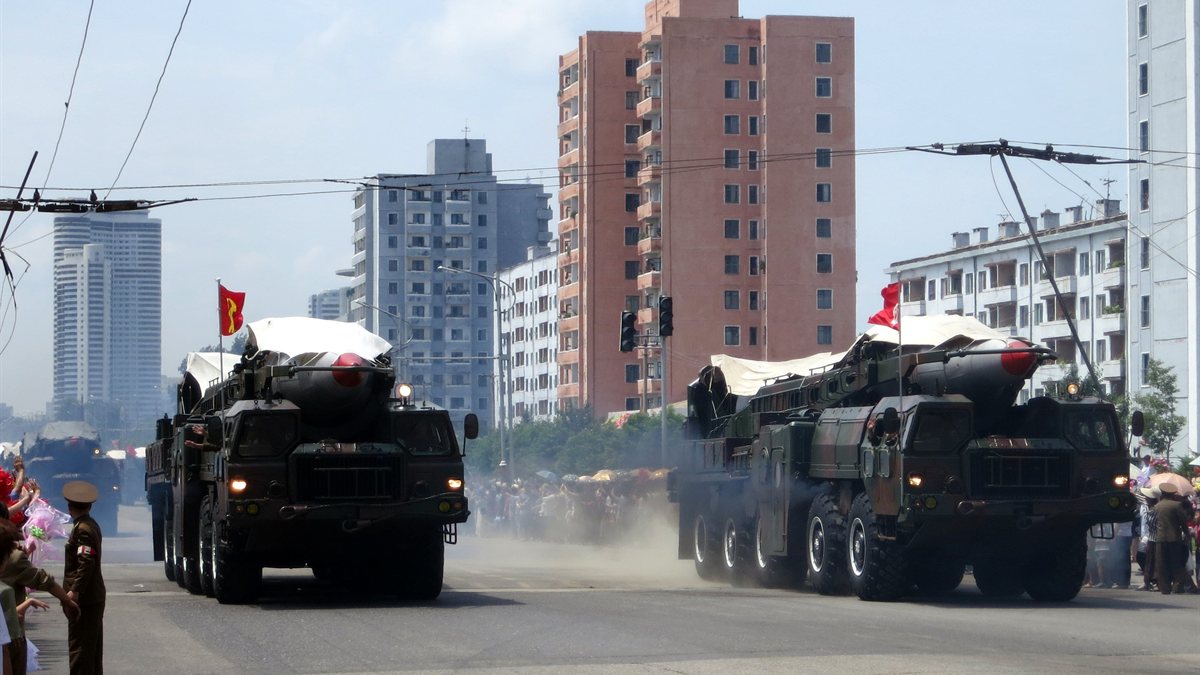
(The Turkish Post) – North Korea fired several ballistic missiles toward the sea off its east coast on the morning of Monday, Oct. 12, South Korea’s Joint Chiefs of Staff said, and one of them flew more than 900 kilometers. The launches came four days after South Korea carried out its first test of a domestically developed hypersonic weapon.
A spokesperson for the Joint Chiefs described the launches as a “show of force” in response to the South Korean test. Seoul’s national security office called them a violation of United Nations Security Council resolutions and urged Pyongyang to stop immediately.
North Korea fires missiles from the Pyongyang area
According to the Joint Chiefs of Staff, the missiles were launched from the Pyongyang area at about 9:20 a.m. local time (0020 GMT) and flew toward the waters off the peninsula’s east coast. The military did not say how many missiles it detected.
Japan’s coast guard reported two projectiles believed to be ballistic missiles and said both appeared to have already fallen. Japanese officials said they landed outside Japan’s exclusive economic zone.
Joint Chiefs spokesperson Jang Do-young declined to say whether the missiles were hypersonic or intermediate-range weapons and said further technical analysis was needed. The South Korean military said the launches may also have been meant to show progress under North Korea’s five-year defense development plan.
After the launch, the national security office held an emergency meeting to review the situation. North Korea had not commented on the launches by Monday afternoon.
South Korea’s first hypersonic weapon test
On Thursday, Oct. 8, South Korea conducted the first flight test of a hypersonic glide vehicle developed in the country. President Lee Jae Myung oversaw the launch at a test site of the state Agency for Defense Development on the country’s west coast.
According to the presidential office, the vehicle separated from its booster, maneuvered vertically and horizontally at hypersonic speed and reached its designated target. Hypersonic weapons travel at five times the speed of sound or faster and can change course in flight, which makes them hard to intercept.
A second launch in nine days
North Korea’s previous ballistic missile launch took place on Oct. 3, from the Wonsan area on the east coast. South Korea’s military said that missile flew more than 700 kilometers, while Japan put the distance at about 680 kilometers.
The official Korean Central News Agency (KCNA) said leader Kim Jong Un oversaw that launch, which it described as a drill for troops operating a “hypersonic strategic weapon system.” The agency said the missile hit a target about 1,000 kilometers away. South Korea said the launch violated Security Council resolutions, and Japan lodged a protest on the same grounds.
Landmine blast raised border tensions
Tension on the peninsula rose after a landmine explosion in the Demilitarized Zone on Sept. 21 wounded three South Korean soldiers. A joint investigation by South Korea and the U.S.-led United Nations Command concluded that North Korean troops had planted the mines.
Pyongyang denied responsibility, called the findings fabricated and accused Seoul of provocation. It warned it would retaliate against any military response.
Kim Jong Un rejects talks with Washington and Seoul
Kim has continued to expand his nuclear weapons program and has rejected offers from Washington and Seoul to resume talks. His summit diplomacy with U.S. President Donald Trump broke down in 2019.
The government in Pyongyang demands that the United States abandon what it calls a “hostile” policy and drop the denuclearization of North Korea as a condition for negotiations. Kim has also deepened ties with Moscow and hosted Russian President Vladimir Putin in Pyongyang in June 2024.
North Korea has been under U.N. Security Council sanctions since 2006 over its nuclear and ballistic missile programs. Security Council resolutions bar the country from any launch using ballistic missile technology.
South Korea’s military said it was analyzing the type and flight data of the missiles fired on Oct. 12.