

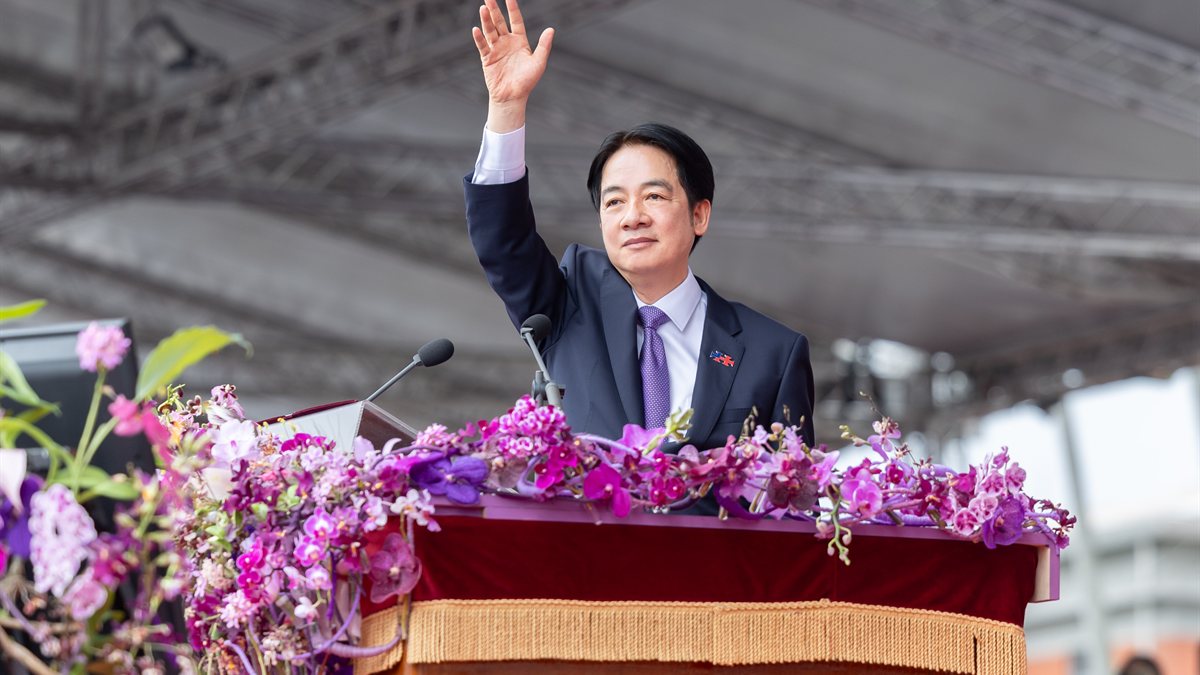
(The Turkish Post) – Taiwanese President Lai Ching-te said on Saturday, Oct. 10, that the island’s rising defense spending is meant to deter a war with China, not provoke one, in a National Day speech that Beijing quickly condemned.
“Our aim by increasing investment in national defense is not to provoke; rather, it is to deter war,” Lai told thousands of people gathered outside the Presidential Office in Taipei, including foreign guests and diplomats.
To fund the higher defense spending, his government has set aside a record 1.1 trillion New Taiwan dollars (about $34.5 billion) for defense in 2027, more than 3% of the island’s gross domestic product.
Lai’s National Day message on peace and freedom
“Taiwan cherishes peace, but we will not give up our freedom,” Lai said. “We are open to exchanges, but will not accept subordination.”
He said China “continues to apply pressure through military and gray-zone activities,” a term for coercion that stops short of open conflict. Taiwan’s resolve, he said, comes down to “whether the international community still believes that force cannot override rules.”
Lai said Taiwan is strengthening its asymmetric capabilities, meaning weapons and tactics designed to make an invasion costly for a larger force, and is building up its own defense industry. He called on democracies in the Indo-Pacific region to “join forces” to preserve the status quo.
He also said Taiwan welcomed the United States and China “managing their competition through dialogue,” but that there “must be respect for the right of the people of Taiwan to exist.”
Beijing rejects the speech
China’s Taiwan Affairs Office, the government body that handles policy toward the island, said the speech “disregards facts, distorts the truth, misleads the public, and reveals ulterior motives.”
It accused Lai of clinging to “Taiwan independence” separatist thinking and exaggerating the threat from the mainland. “There is only one China in the world, and Taiwan is part of China,” the office said, adding that Taiwan’s future must be decided jointly by all Chinese people, including those in Taiwan.
Beijing claims Taiwan as its territory and has not ruled out using force to bring it under its control. It has rejected Lai’s offers of talks and calls him a separatist.
Defense spending and a pending U.S. arms package
Lai pledged last year to raise defense spending to 5% of GDP by 2030. The record 2027 budget is the latest step toward that goal.
Alongside its own defense spending, Taiwan is waiting for U.S. President Donald Trump to approve a $14 billion arms package that includes the Patriot air defense system. In May, after meeting Chinese President Xi Jinping in Beijing, Trump suggested that arms sales to Taiwan could be used as a bargaining chip with China, a remark that alarmed Taiwan’s supporters. Officials in Washington and Taipei say U.S. policy toward Taiwan has not changed.
The United States switched diplomatic recognition from Taipei to Beijing in 1979 but remains Taiwan’s most important source of weapons and security support.
Growth figures and foreign guests
Lai said Taiwan’s economy grew 14.15% in the first half of the year and could grow more than 11% for the full year, which he said would be a 39-year high. He announced monthly allowances of 5,000 New Taiwan dollars for every child from birth to age 18 starting next year.
Fighter jets and two Chinook helicopters carrying giant Taiwanese flags flew over Taipei before the speech. Eswatini’s King Mswati III, the leader of Taiwan’s only diplomatic ally in Africa, attended the celebrations during a state visit, his 20th trip to the island. A delegation of Japanese lawmakers was also in the audience. The ceremony was chaired by parliament speaker Han Kuo-yu of the opposition Kuomintang, which favors closer ties with China.
The holiday marks the anniversary of the 1911 uprising that brought down China’s last imperial dynasty. Taiwan, home to about 23 million people, is formally named the Republic of China. Its government moved to the island in 1949, when the nationalist forces of Chiang Kai-shek lost China’s civil war to Mao Zedong’s communists.


